Medellín

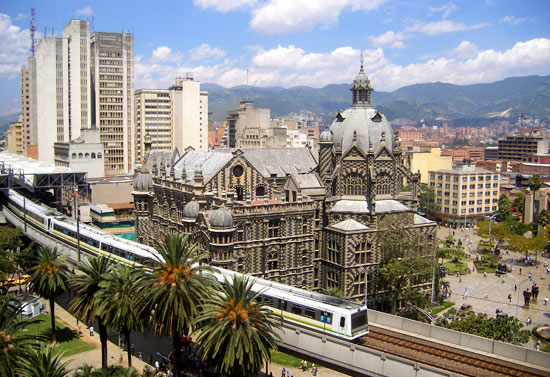
Plaza Botero and Metro

Department: Antioquia

Population: 2.5 million

Altitude: 1,500m

Climate: warm (av. temp. 22ºC)


Medellin, Colombia’s second city, is known as ‘la capital de la montaña’ (the mountain capital) due to it being nestled in a valley and so flanked by mountains to both the east and west. Indeed a large part of the city is built on the slopes of the mountains. Medellin is also commonly known as ‘la ciudad de eternal primavera’ (the city of eternal spring). Paisas (people hailing from Medellin) will tell you though that the climate here has changed considerably in the last 5 years or so, with each year seemingly receiving more rain. Be that as it may the temperature here remains extremely comfortable tending to range from low to mid-twenties during the day.

The people from Medellin are commonly known as ‘paisas’. The name also refers to people from the coffee region of Colombia although it is almost always associated with people from Medellin and its department Antioquia. Paisas are arguably Colombia’s friendliest people (at least they will tell you they are!) Paisas have developed a reputation for being not just friendly, but also hardworking and entrepreneurial. The paisa girls are also undeniably beautiful, probably only matched by girls from Cali. Medellin is also the cosmetic surgery capital of Colombia and it’s quite common to see girls with very obvious ‘silicon enhancements’.

Glamorous Paisa girlMedellin is not a city with a huge number of tourist attractions. Its appeal lies more in its atmosphere, its people, its nightlife and its proximity to the stunning towns and countryside of rural Antioquia. That said there are certainly some must-see attractions within the city which are mentioned below. See also the sections on Antioquia for information about its towns and countryside.

Things to see and do

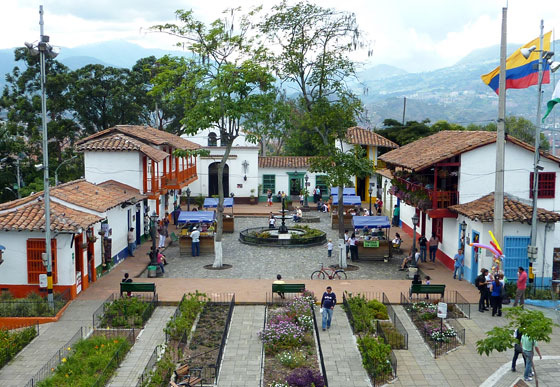
Pueblito Paisa:

This is one of Medellin's most famous landmarks. Pueblito Paisa is a mock-up of a typical, colonial Pueblito Paisa, Medellinstyle Antioquian town complete with central plaza and surrounding shops and houses. Personally I think it's a bit disappointing. The view from the top of the hill on which it's located is worth a trip though. There is a viewing platform where you view the downtown skyline and snap some photos. If you want a real paisa town experience my advice is simple; visit one. (See the Antioquia guides for info on the many beatiful towns in this department situated between one and four hours from Medellin).

Metro Cable:

You'd probably expect this information be included in the 'Transport' section (further down this page), but Medellin's Metro Cable is a tourist attraction in itself. There are now two cable car lines feeding off the main Metro lines. The first begins it's ascent at the Metro station 'Acevedo' on the Metro A line and climbs to the east passing stations Andalucía and Popular I before its final stop at Santo Domingo. The route passes over some of Medellin's poorer and more colourful neighbourhoods and gives an impression of how the majority of people live in the city. As so many hotels and hostels are located in the swanky south many tourists would probably leave Medellin without this impression if it weren't for the Metro Cable.
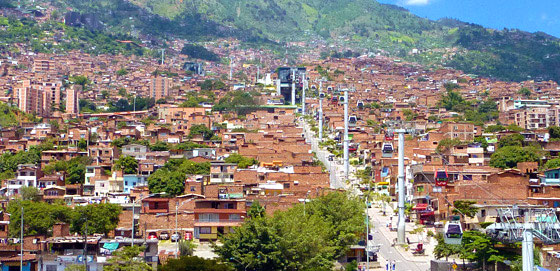
    Metro Cable

Another good reason to make the trip is for the view across the city that awaits you at the top of the line. There is a smallish plaza down to the right of the Metro Cable station as you look out at the city from where you can get some decent photos ona clear day (for this reason it's generally best to go in the morning). Just next to this plaza is the large, conspicuous library called Parque Biblioteca España. It was inaugurated in 2007 by the king of Spain whose country made considerable contributions to its construction.
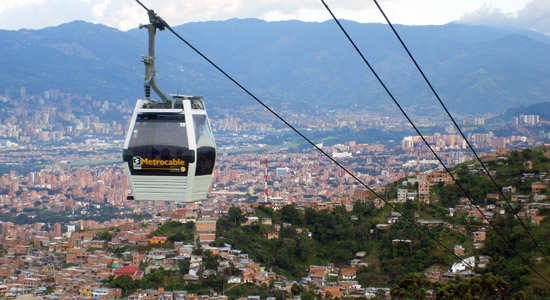
Metro CableIf you choose to wander around the neighbourhood of Santo Domingo keep your wits about you. The area around the Metro Cable station is well policed, but Santo Domingo remains one of Medellin's poorer neighbourhoods and there is still paramilitary activity here aswell as general crime. As always, the chances of something bad happening are pretty slim, but it's probably best to do any serious neighbourhood walking here with another Colombian, especially at night (and you might find convincing a lot of Colombians, especially from the south of the city, to go with you a bit difficult).

Plaza Botero:

Spend enough time in Colombia, especially in Medellin, and you'll come across some peculiar paintings and sculptures by a Paisa artist named Fernando Botero. This is Colombia's most famous artist and whose speciality is painting/sculpting his subjects (primarily people, fruit and horses) in a bloated, chubby style. His works are ubiquitous around Medellin and can be found on the walls of restaurants, the sides of buildings, friends houses and in plazas. The plaza with the largest collection of his sculptures, and which is named after him, is Plaza Botero.
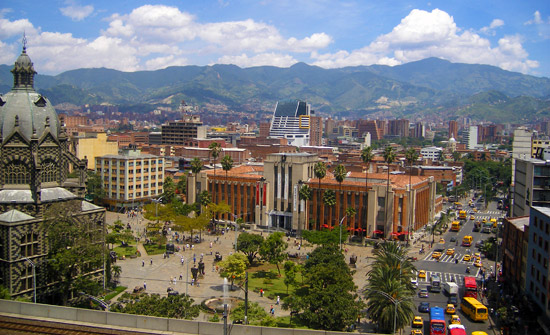
Located in downtown Medellin next to the Metro station 'Parque Berrio', Plaza Botero is a pleasant place to spend a few hours. Aswell as the sculptures there are some small grassy areas to relax in and the odd looking Palacio de la Cultura is definitely worth a photo or two. Also located on the plaza is the Museo de Antioquia (info below).

    Museo de Antioquia, Medellin

Museo de Antioquia:

Medellin's most important museum, el Museo de Antioquia' (photo above) is located in Plaza Botero on the opposite side to the Metro line. It comprises 3 floors of works by various national and international artists. There are also regular exhibitions. See the museums official website for details.

Jardin botanico

Jardin BotanicoUntil 2006 the botanical garden of Medellin was poorly maintained and infrequently visited. In 2007 it was transformed and has become a very popular place to escape from the hustle and bustle of the city. Its centrepiece is the 'Orquideorama' an interesting architectural structure which houses a variety of orchids and other speicies of flowers. The Botanical garden is a terrific place to come to relax, especially during the week when it is less crowded. There are also frequent concerts, exhibitions and fairs held here. There is also a great restaurant called In Situ. Try their fruit juices!

Parque de los Pies Descalzos

On the opposite side of the Metro line from Parque Explora and the Jardin Botanico is a paved 'park' very popular with families. Kids seem to have a decent time there running through the fountains and playing in the sand area and there are various cafes offering refreshments. Medellin's planetarium is also found here.

Parque ExploraParque Explora (including Aquarium)

Medellin's answer to Bogota's science park 'Maloka' is the impressive Parque Explora. It was inaugurated at the end of 2007 and remains incredibly popular, especially with families. In the area outside the principal building are a variety of interactive hands-on science attractions which demonstrate various fundamentals of mechanics. The building itself features various rooms containing all manner of interactive science displays and also a special 3D room.

Parque Explora's main attraction is the aquarium which is currently South America's largest. The aquarium displays an impressive range of aquatic life (although there are currently no sharks) and the guides are friendly and knowledgeable.

Check out Parque Explora's website for more information.
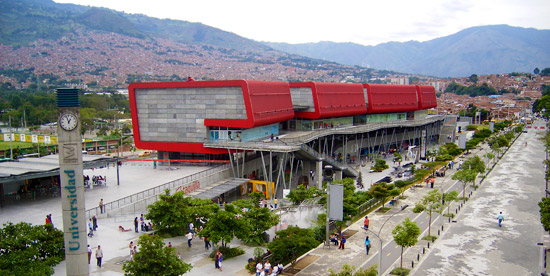
    Aquarium, Parque Explora, Medellin

Accommodation

Budget:

El Poblado (near 'La Zona Rosa' - nightlife district):

Black Sheep: Transversal 5a No. 45-133 Tel.(4) 3111589, Cel. 3113413048 website

One of the original hostels in the El Poblado sector of Medellin, the Black Sheep Hostel has a great reputation among travellers. Run by a Kiwi called Kelvin the hostel is a handy 8 minute walk from the El Poblado Metro station and includes hot showers, internet (inc. wi-fi), TV, DVDs, and laundry service.

Casa Kiwi: Carrera 36 No. 7-10 Tel. (4) 2682668 website

Another of El Poblado's traditional and reputable hostels is Casa Kiwi. Situated a couple of blocks up from Parque Lleras (the main nightlife hangout) it includes hot water showers, kitchen, a pool table, TV, DVDs, bicycle rental.

Sunshine Hostel: Calle 9 No. 43C-36 Tel. (4)5820305 website

Another popular choice, located half a block down from Parque Poblado (which is about a 5 minute walk from Parque Lleras). Includes internet and TV.

Pit Stop Hostel: Carrera 43e No. 5-110 Tel. (4) 3521176 website

Pit stop is another good option in this area. Incuded are hot showers, a pool table, TV, DVDs, Irish sports bar (live sport), basketball, small gym and steam room.

Tiger Paw Hostel: Carrera 36 No. 10-49 Tel. (4) 3116079 website

Tiger Paw is almost spitting distance from Parque Lleras, ideal for party animals. Hostel includes pool table, roof terrace, XBox, hot water, free internet, TV and sports bar. Airport pick up is also offered.

Casa Mayde: Calle 10 No. 37-39 Tel. (4) 3121248 email: casamayde@yahoo.com

Another hostel with a location close to Parque Lleras.

Other parts of the city:

Palm Tree: Carrera 67 No. 48D-63 Tel. (4) 2606142 Cel. 3002419209 website

Palm Tree is one of Medellin's first hostels and although not perhaps as slick and modern as some of the El Poblado hostels it remains very popular with travellers. Located in the Suramericana neighbourhood (a few blocks from Suramericana Metro station) it includes free internet, free BBQ on fridays, bicycles for rent, bar, kitchen. The stadium and a huge range of sports facilities are also very close by.

Casa del Sol: Calle 49 No. 81A-24 Tel. (4) 4220531 website

Located in the Calasanz neighbourhood, Casa del Sol is a good bet for those wanting to get away from the El Poblado party scene. It is conveniently located a few blocks from La Floresta Metro station and includes breakfast, games room, internet, kitchen, bar and a book exchange.

Vica Hostel: Calle 32 No. 80-70 Tel. (4) 4115340 Cel. 3165897792

Another option is Vica Hostel is located close to the intersection of Carrera 80 and Calle 33 (a street full of restaurants, bars and nightclubs).

Hotel Dann CarltonTop End Hotels:

Dann Carlton: Carrera 43A No. 7-50 Tel. (4) 4445151 website

The Dann Carlton Hotel (photo right) Located in the business district of El Poblado and featuring the usual array of luxury facilites.

Hotel San Fernando Plaza: Carrera 42A No. 1-15 Tel. (4) 4445353 website

Another good option located in the El Poblado business sector.


Nightlife

Parque Lleras in the neighbourhood of El Poblado is where the trendy and the beautiful hang out. The area around the park is filled with restaurants, bars and discotecas mostly at the pricier end of the scale.

Alternatives to Parque Lleras include the increasingly popular 'La 33' (calle 33), aswell as 'La Setenta' (carrera 70), and 'La Ochenta' (carrera 80). The city centre also has some decent night spots.

Food and Drink

Paisa food (food from Antioquia) is quite distinct from elsewhere in the country. The most popular dish is the 'Bandeja Paisa', a large meal consisting of beans, rice, a fried egg, meat, sausage, plantain, and anything else they choose to throw on. Think of it as a Colombian version of a Full English breakfast and you're not too far off.

Also popular in these parts is the arepa, a cornmeal roll that comes in various forms and sizes and typically with a topping called 'hogao', a mix of tomato and onion.

Shopping

Santa Fe shopping centre, MedellinShopping malls are popping up all over Medellin. The biggest and most exclusive is Centro Comercial Santa Fe (photo, right) which opened in 2010. This huge shoppong centre contains four floors and includes a cinema and large food court. Other shopping centres in the El Poblado district include El Tesoro and Oviedo. Also popular are Unicentro, Los Molinos and Premium Plaza which have a more central/western location.


Sport and Recreation

Football:

Nacional fansMedellin's two big football clubs are Atletico Nacional and Deportivo Independiente Medellin. Nacional has the bigger following and a larger trophy cabinet (they proudly, others would say arrogantly, call themselves the 'Rey de Copas' (king of cups) due to thier 10 domestic championships and the 1989 victory of the prestigious Copa Libertadores (South America's version of the European Cup)). Medellin have a more modest history, but have calimed a couple of championships in recent years (in 2002 over arch-rivals Nacional and in 2009 against Atletico Huila).

Both teams play their home games at the Atanasio Giradot stadium (take Metro line B to Estadio station) which has a capacity of around 45,000. Clasico (derby) day is an awesome spectacle. Many paisas will tell you to avoid the stadium when clasicos are being played, however it's not as dangerous as they would have you believe and if you sit in the pricier parts of the Independiente Medellin fansstadium, wear a neutral coloured shirt (white usually does the trick) and refrain from throwing flares at opposing fans you'll almost certainly be fine.

Envigado football club, situated just outside the metropolitan area, also currently play their football in the top league. They play their matches at the small Polideportivo Sur stadium. They have never won a title, but occasionally reach the playoffs.

Antioquia's other two teams are Rio Negro and Bajo Cauca. Both currently play in Division B, although Rio Negro came mighty close to winning promotion to the top flight, but lost on aggregate to Envigado in the relegation/promotion playoff of 2008.

In March/April 2010 Medellin held the Juegos Suramericanos (South American Games). The games were a resounding success and ended with Colombia atop the medals table for the first time in the games' history.

    Basket ball match in the Juegos Suramericanos, Medellin 2010

Festivals

Feria de las Flores (Flower Festival):

La CabalgataEasily the most important festival in Medellin, La Feria de las Flores combines horse riding, vintage car parades, flower-decorating and copious alcohol consumption. It's a week long affair taking place in August during which the city typically enjoys beautiful weather. On the first weekend the Cabalgata (Horse Parade) is held. A huge stretch of the city's main highway is cordoned off along which hundreds of horses are paraded, although it often seems like the beautifully dressed up paisa girls mounted on the horses are the ones being paraded. That said, most people are too busy getting hammered to ponder the difference. The tipple of choice is a liquor known as aguardiente, an aniseed drink which I personally find repulsive, but is adored by huge numbers of Colombians and foreigners alike. Being the friendly, generous bunch they are, random paisas will often thrust a shot of 'guaro' (as arguardiente is often called) in your direction. Resistance is futile.

The festival continues throughout the week with various events such as concerts and shows being held throughout the city.

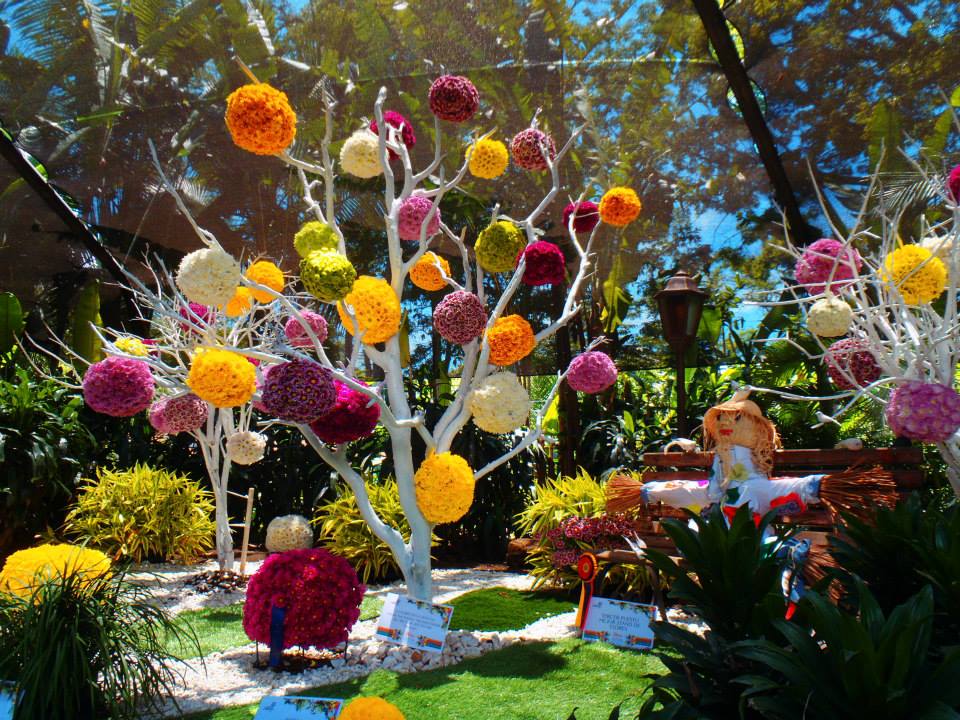
A typical flower decoration at the Feria de las FloresThe climax is the second and final weekend during which country folk known as 'silleteros' (flower-bearers being about the best translation I could come up with) carry huge decorative flower displays (silletas) down from a small town called Santa Elena up in the mountains to the city centre. Even more astonishing than the beautiful decorations is the fact that they weigh an absolute ton and are often carried by elderly men and women. Both this event and La Cabalgata are extremely popular, so if you want to get a good vantage point (especially for the Silleteros parade) it's best to be early.

Los Alumbrados (Christmas lights):

Before I came to live in Colombia my idea of Chistmas lights in my native Britain was standing in the freezing cold on a wet November evening watching a soppy ex-Big Brother contestant turn on some tatty-looking lights on one of the city's Christmas lights on the Medellin Riverhigh streets, and wondering why I wasn't in a nice warm pub instead. Medellin's Christmas lights, however, are a different kettle of pescados altogether. There are well-thought out, attractive displays located all over the city, but by far the most impressive are the lights suspended over the Medellin River. For hundreds and hundreds of metres people walk along the banks of the river gazing at the simply stunning decorations suspended above the flow of water. A picture says a thousand words, but even a picture can't really sum up the incredible spectacle of these lights and decorations. The photo on the right at least gives you some idea of the treat awaiting you if you're lucky enough to be in Medellin during the Christmas period. The lights usually last from the start of December to mid January.

Transport

Within Medellin:

A source of great pride for many 'paisas' is the city's Metro system (the first and only one in Colombia, at least until Bogota builds its version.) The Metro consists of two lines A and B. Line A (the longer of the two) runs from north (at Niquia) to south (at Itagui), although work is currently being undertaken to extend the line to Sabaneta. Line B runs from San Antonio (in the city centre) to San Javier in the west. The two lines connect at San Antonio. Due to the pride that the paisas take in their Metro it is probably the cleanest and most well-respected mass transit system in South America.

Taxis are relatively cheap and are all metered. Hailing taxis on the street is generally very safe.

Buses run to all parts of Medellin. As with all the major cities in Colombia, working out the routes can be a bit confusing so ask for advice on which bus(es) to take rather than standing at the side of the street attempting to read the placards in the bus window as they rush past.

To and From Medellin:

Medellin has two bus terminals. Buses in the Northern terminal (situated at Caribe Metro station) go to all destinations in the north such as Cartagena (13 hours), Santa Marta (16 hours), but also Bogota (9 hours). Buses leave the Southern Terminal for southern destinations such as Manizales (4 hours), Pereira (5 hours), Armenia (6 hours) and Cali (8 hours).

Medellin has two airports. Olaya Herrera Airport is located in the south of the city near the Southern bus terminal. Flights from this airport are domestic only. The newer Jose Maria Cordaba Airport is situated near the town of Rio Negro about 50 minutes outside Medellin. Both domestic and international flights leave from this airport. Domestic flights with Colombian airline Avianca only leave from this airport.


Copyright © 2009 All Rights Reserved