Quibdó

Quibdo during San Pacho


Department: El Chocó

Population: 150,000

Altitude: Sea level

Climate: Hot, humid, wet (average temp. 30ºC)


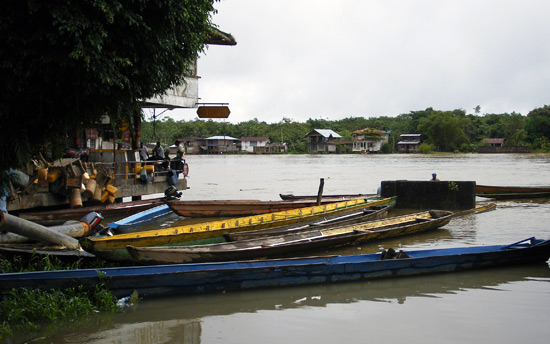
Quibdó is one of Colombia’s most isolated cities. It is located on the bank of the Atrato River which snakes through virgin jungle leading to the Caribbean Sea and which at one time was considered as a possible route for a canal passing through the Americas before the Panama canal had been constructed.

Although situated just a 25 minute plane ride from Medellin the two cities appear as if they were from different continents let alone from the same country. This region is officially the wettest in the world. It is very rare to see 24 hours pass without a torrential downpour, and it does little to provide relief from the intense heat. Quibdó is capital of the department of Chocó and is officially a city, but it bears much more resemblance to a large town. Pretty much only the city centre has paved streets and concrete buildings, with the outskirts formed off dirt tracks and shacks made of wood or corrugated iron. There is no decent water or sewage system in place to the extent that despite being in the wettest region on the planet there are occasional droughts as stored water quickly runs out.

Quibdó and a large part of Chocó also continue to suffer from the presence of guerrilla group the FARC. Guerrilla related murders and kidnappings continue in this part of Colombia and tragedies continue to occur on a regular basis. That said Quibdó has a strong army presence and you shouldn’t experience any problems if you stay within the city boundaries. The security Atrato Riversituation is constantly changing is to ask the police / military for advice on whether any of the towns around Quibdó are safe to visit. The few westerners who travel to remote towns and villages tend to be with aid organisations and are supposedly protected from the guerrilla. In fact the vast majority of foreigners in even the city of Quibdó are with aid organisations. It’s quite common to see official UN World Food Organisation cars bumping along Quibdo’s streets.

Despite these problems the people of Quibdó are incredibly friendly and welcoming of tourists. They are very proud of their city, but also accepting of its flaws. The biggest criticism people in this city have is corruption. A lot of the money Quibdó receives from the capital has a habit of mysteriously disappearing. An example of this is the road that has been planned from Quibdó to the pacific coast. The plan has existed for years, but money has vanished and the road has barely been started.

Things to do / Places to go

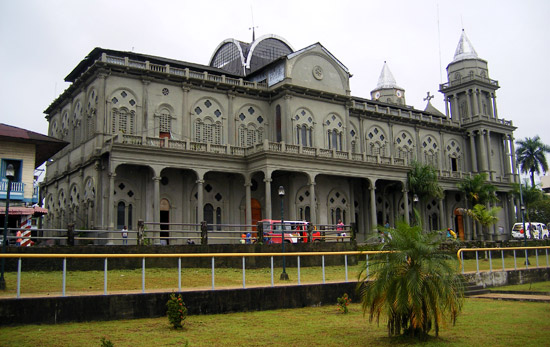
CathedralTourist attractions in Quibdó are few and far between. El Catedral de Quibdó (see photo right) is probably Quibdó’s biggest landmark, sitting on the bank of the Atrato River. From the cathedral it is worth taking a stroll into the small downtown area to visit the colourful markets and generally people watch. Most essential such as banks, restaurants, small stores and hotels can be found here. It is possible to go outside the centre into some of the poorer areas, but do so with caution. If possible go accompanied or at least check at your hotel or ask a police officer to make sure the area you intend on going is ok.

Food and Drink

The staple here is fish. Pretty much any restaurant you could choose to enter offers fish, usually fried or in a soup (called Sancocho). You can find lots of exotic fruits here that aren’t so common in other parts of Colombia. My personal tip is to try ‘borojó’ juice, a delicious fruit that is supposedly an aphrodisiac, so be warned!

Festivals

The festival of San Francisco, more commonly known as San Pacho, transforms the streets of the Chocó capital into a mass of colour, music, dancing and celebrating.

Celebrating San PachoSan Pacho lasts for 3 weeks, beginning around the middle of September and finishing in early October. The various neighbourhoods in Quibdó take it in turns to hold the festivities, but as the city is quite small the merriment is never more than a short taxi ride away. The celebrations usually take the form of music and dance on small stages with stalls offering refreshments.However, the real heart and soul of San Pacho is a huge dancing procession through the streets called the 'bunde'. This is a mixture of groups of performers wearing costumes, and the public, of which you are included if you so desire! It can be pretty intense though; hours of being pulled along by the dancing crowd in hot, humid weather, with rum being periodically poured down your throat. And should you decide to take a break from dancing and walk for a block expect a barrage of 'Baile! Baile!' (Dance! Dance!). It's fantastic fun though and great to be experienced at least once.

Sport and Recreation

Despite being an almost constant source of quality footballers; Alexis García (ex-Nacional and winner of the Copa Libertadores), Bonner Mosquera (ex-Millonarios legend), Hamilton Ricard (ex-Middlesbrough) and Wason Rentería (ex-Porto and currently with Atlético Mineiro) to name but a few, Quibdó and El Chocó still don't have a professional football team. However, in 2008 it was announced that a stadium complete with a full-sized artificial pitch will be constructed just outside Quibdo. This may be an important step in Quibdó finally getting a team. Until then, Chocó's next footballing heroes will be reared from the city's streets and dusty parks.

Accommodation


Both of the following hotels are located near the Atrato River near the cathedral and opposite the police station.

Hotel Los Robles: Calle 28 # 1-88, Tel. 712395

Quibdó's most exclusive hotel. The hotel has 6 floors including a couple of conference rooms, a dining room serving breakfast, lunch and dinner and a small internet room. Rooms have cable TV, air-con (a necessity!) and en-suite showers.

Hotel Camino Real: Calle 28 # 1-124, Tel. 3104329471

This hotel, next to Hotel Los Robles, is friendlier than its neighbour. It is less elegant, but also cheaper. The rooms come with cable TV, air-con and en-suite showers. They offer free transport to the airport. The owner, who you'll typically find sitting on the second floor terrace sipping a beer, is charming and will do his best to make your stay comfortable.

Transport

The airport is located on the outskirts of town. The earliest flights leave at around 7am with the last flight at about 6pm. Be warned that flights are very frequently cancelled due to weather conditions (This has happened twice to me!). Try getting to El Choco junglethe airport early as flight times are sometimes put forward without prior notice, or if a flight is cancelled there is the possibility of being bumped forward to an earlier flight.

The half hour flight from Medellin to Quibdó is fascinating. After 15 minutes in the air, the jagged mountains of the western range of the Andes very quickly give way to the virgin jungle of El Chocó. The change in landscape is almost instantaneous. The enormous stretches of jungle are occassionally interrupted by a muddy track or sometimes a small cluster of houses, but the vast majority of this thick jungle is still completely untouched and unexplored.

A taxi to the centre of Quibdó (including the above hotels) will cost about $5,000. You can also take a motocycle taxi (known locally as 'rapimotos') which will charge you just $1,000 (for any trip within the city), although you're likely to risk your neck as you weave through the busy, pot holed roads (there are still no traffic lights here). Consider paying the driver $2,000 - the tip will be very much appreciated. Many of the rapimoto drivers are very friendly and it's possible you'll find yourself conversing about anything from Colombian politics to the quality of the local women.

It is possible to travel to Quibdó by bus from Medellin. Be warned though that the road is very bad and subject to the incredibly wet weather. In february 2009 a bus full of passengers travelling from Medellin to Quibdó slid off the road down into the Atrato River killing at least 25 people. Disasters of this type are, however, very uncommon. Long delays due to landslides are very frequent though.


Copyright © 2009 All Rights Reserved